What a commercial invoice is for
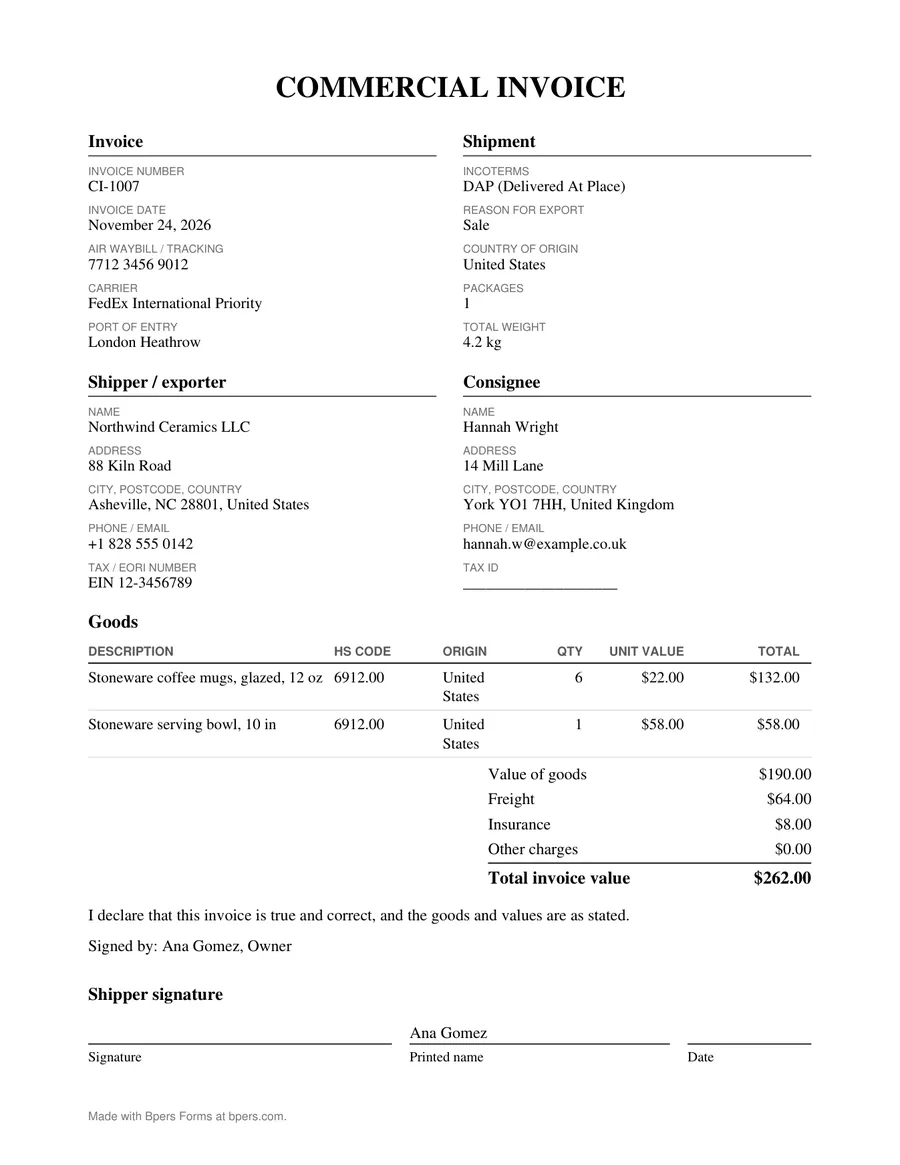
A commercial invoice is the customs document that travels with goods crossing a border. Customs officers use it to see what is in the box, where it was made and what it is worth, which is how they work out any duty and tax. The carrier will usually ask for it before an international parcel or freight shipment can leave.
It is different from the ordinary invoice you send a customer to get paid: it is written for customs, so it describes the goods in detail and states their value even when nothing is being sold, such as a gift or a sample.
What US customs expects on it
For goods imported into the United States, the federal rule on invoice contents (19 CFR 141.86) lists what each invoice must show. In plain terms:
- The port of entry the goods are going to.
- Who sold to whom, when and where, or, if nothing was sold, who shipped it, to whom and from where.
- A detailed description of each item: its name, grade or quality, and the marks and numbers it is sold under, plus the marks on the packages.
- Quantities, in the weights and measures of the country it ships from or of the US.
- The price of each item in the currency of the purchase, or its value if it was not bought.
- Every charge by name and amount: freight, insurance, commission, packing and so on.
- Any discount from the list price, for each kind of goods.
- The country of origin.
The same rule says the invoice must be in English or come with an accurate English translation, and must show what is in each package. Other countries have their own rules, so check with your carrier or the destination's customs website for anything extra they need.
Filling it in
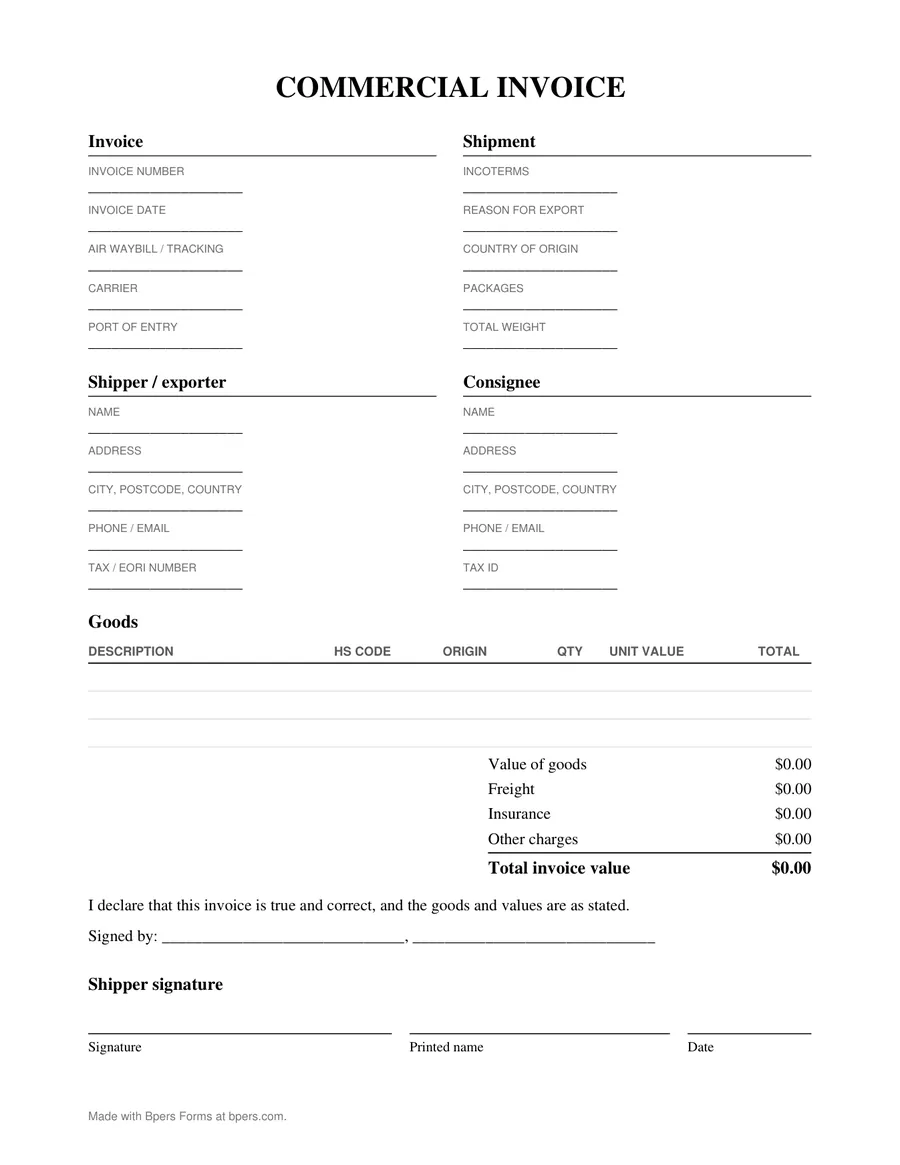
- Shipper and consignee. The shipper (exporter) is you; the consignee is the person or business receiving the goods. Add a tax or EORI number if you have one: shipments to the UK and EU often need it.
- One line per kind of item. Describe it the way a customs officer would understand it: "Men's cotton t-shirts" rather than "clothing".
- HS code. The Harmonized System code classifies the goods for customs. Use the code your customs authority publishes: in the US that is Schedule B for exports and the HTSUS for imports. Your carrier's website usually has a lookup.
- Country of origin is where the goods were made, not where you ship them from. Fill the default once; change it on any line that differs.
- Value. Give the real price paid, or a fair market value for gifts and samples. Add freight and insurance on their own lines, as customs asks for each charge separately.
- Sign and date it. The declaration is your statement that everything on it is true.
Incoterms in one minute
Incoterms are short codes that say who pays for transport, insurance and import duties, and where responsibility passes from seller to buyer. The two you will see most on small shipments:
- DAP (Delivered At Place): the seller pays to get it to the buyer's address; the buyer pays import duty and tax on arrival.
- DDP (Delivered Duty Paid): the seller pays everything, including the duty, so the buyer has nothing to pay.
If you are not sure, ask your buyer which they agreed to, and use the same code your carrier label shows.
Mistakes that hold shipments at customs
- Vague descriptions such as "parts", "gift" or "samples" with no detail.
- A value of zero. Even free samples need a realistic value.
- Totals that do not match the carrier's paperwork.
- A missing signature, or only one copy. Most carriers ask for three: one in a pouch on the outside, one inside the box, one for you.
Common questions
Is a commercial invoice the same as a pro forma invoice?
No. A pro forma invoice is a quote or advance bill sent before the sale is final. The commercial invoice is the final document for customs once the goods ship.
Do I need one for a gift?
Usually yes for international parcels: carriers and customs want a description and value even when nothing was sold. Choose "Gift" as the reason for export and give a fair value.
Which currency should I use?
The currency of the sale. US customs asks for each item's price in the currency of the purchase. Pick it in the settings beside the invoice; every amount changes with it.
Where do I find the HS code?
In the US, search Schedule B (exports) or the Harmonized Tariff Schedule (imports). Most carriers also have a free lookup in their shipping tools.
How many copies do I need?
Check with your carrier. Three signed copies is common: one attached outside the box, one inside, and one for your records.
Sources
Last checked November 26, 2026.