Finding the trailer's VIN
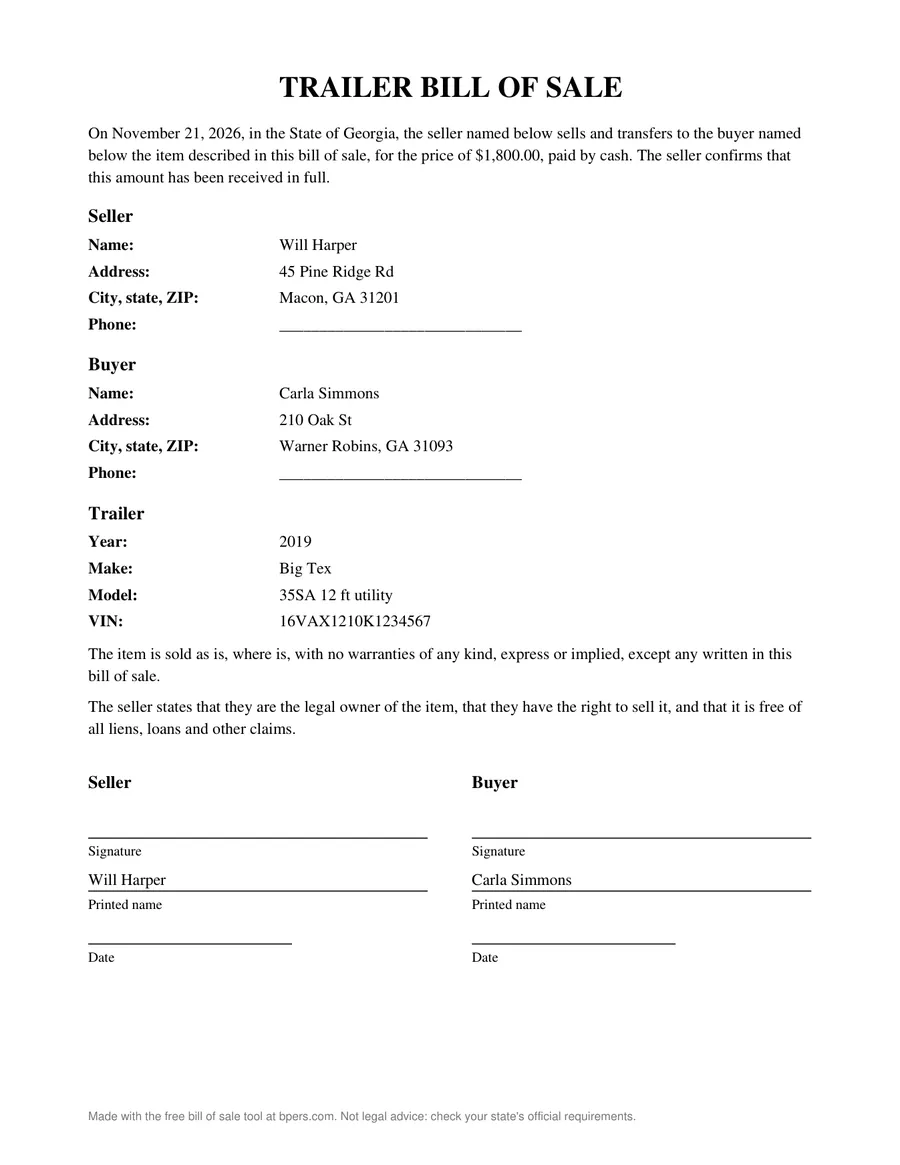
Trailers built for the road have a 17-character VIN, usually on a plate or sticker on the tongue or the front of the frame. Check it against the title or registration.
Homemade trailers often have no VIN at all. If yours doesn't, the buyer's DMV will explain how to get one assigned before it can be registered.
No odometer statement needed
Trailers are not self-propelled, so the federal odometer disclosure doesn't apply to them (49 CFR 580.17). That's why this sheet has no mileage line.
Checks before you hitch up
A buyer should look at what wears out on trailers: tires (cracks and the date code on the sidewall), wheel bearings (spin each wheel and listen), the lights and wiring plug, the coupler and safety chains, and the brakes if it has them. Rust along the frame and tongue matters more than surface paint. Agree in "Other terms" on anything the seller will fix before handover.
Selling it with a boat or camper
If the trailer is sold together with a boat, make a boat bill of sale too, so each has its own record. A travel trailer you sleep in belongs on the RV bill of sale.
After the sale
- Seller: sign over the title if the trailer has one, and keep your copy of this bill of sale.
- Buyer: title and register the trailer if your state requires it. Many states decide this by weight.
Common questions
Do small trailers need a title?
It depends on your state, and often on the trailer's weight. Some states only register light trailers; some do neither.
Does this work for a horse trailer?
Yes. Any trailer that isn't a camper or living quarters fits here.
What if the trailer has no VIN?
Write the serial number if there is one, or describe it under "Other terms". The buyer's DMV will explain how to get a VIN assigned.
Sources
- 49 CFR 580.17: odometer disclosure exemptions (eCFR)
- 49 CFR Part 565: vehicle identification number requirements (eCFR)
Last checked November 26, 2026.