What is a bill of sale?
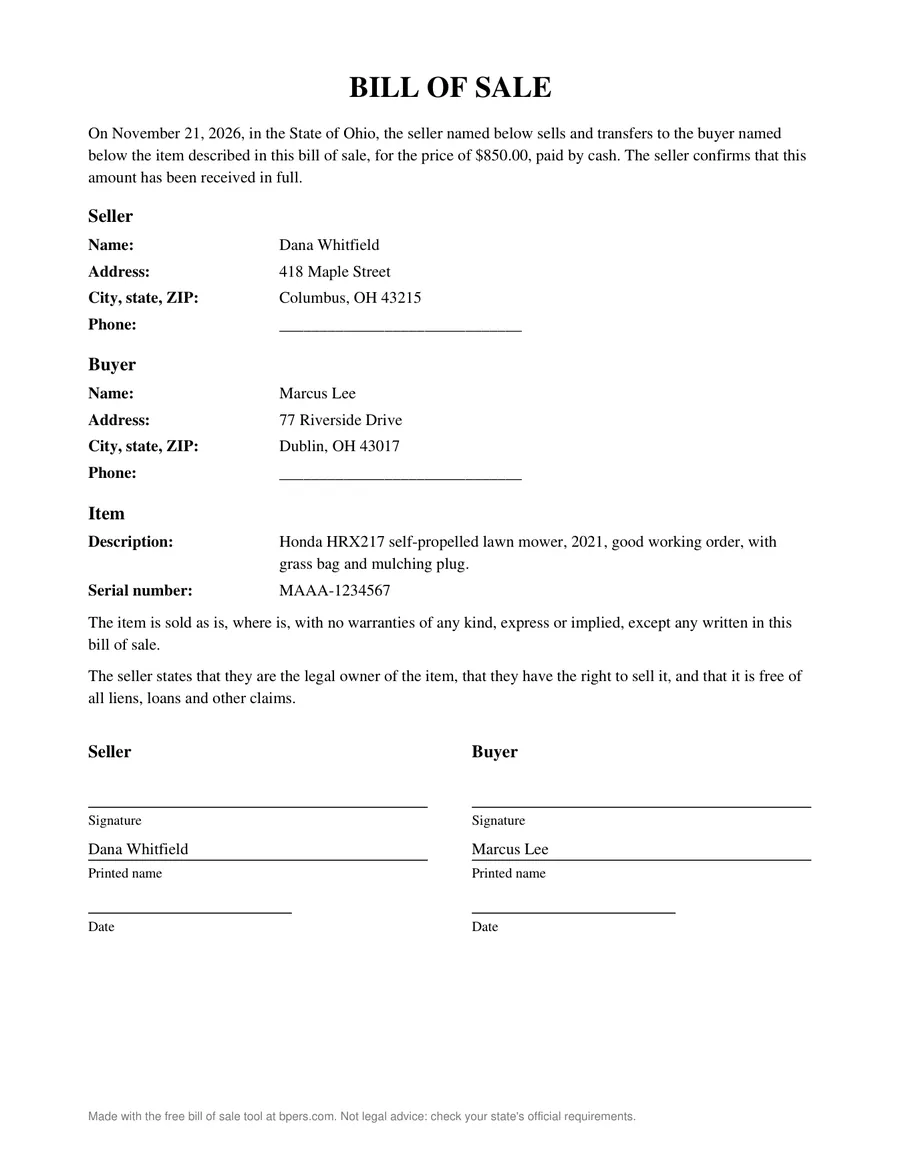
A bill of sale is a short written record that one person sold something to another: who sold it, who bought it, what it was, the price, and the date. Both people sign it and each keeps a copy.
It is your proof of the deal. The buyer uses it to show they own the item and what they paid for it. The seller uses it to show the item is no longer theirs, which matters if a car they sold later gets a parking ticket or is in an accident.
For a car, motorcycle, boat or trailer, a bill of sale does not replace the title. In most states the title is what legally transfers ownership, and the bill of sale sits alongside it. Some states require a bill of sale to register the vehicle; others only recommend it.
A version for what you are selling
This page works for anything. For vehicles and boats there is also a version with the right lines and advice already in place:
- Car bill of sale (cars, trucks, SUVs, vans)
- Motorcycle bill of sale
- Boat bill of sale
- Trailer bill of sale
- RV bill of sale (motorhomes and campers)
- Mobile home bill of sale
- ATV and golf cart bill of sale
Each state's official form, notary rule and deadlines are on bill of sale requirements by state. Guides: how to write a bill of sale and does a bill of sale need to be notarized?
How to fill in this bill of sale
- Choose what you are selling. The form shows the right fields: VIN and odometer for vehicles, hull ID for boats, a description for anything else.
- Enter both people's names and addresses exactly as they appear on their driver's licenses.
- Copy the VIN or hull ID from the item itself, not from an ad, and check it matches the title character by character.
- Write the real price. Many states charge sales or use tax on the price, and an understated price on a signed document can cause problems at the DMV.
- Download the PDF (or press Print), print two copies, and both sign and date each one when the money changes hands.
Any field you leave empty prints as a blank line, so you can also print an empty bill of sale and fill it in by hand.
What a bill of sale should include
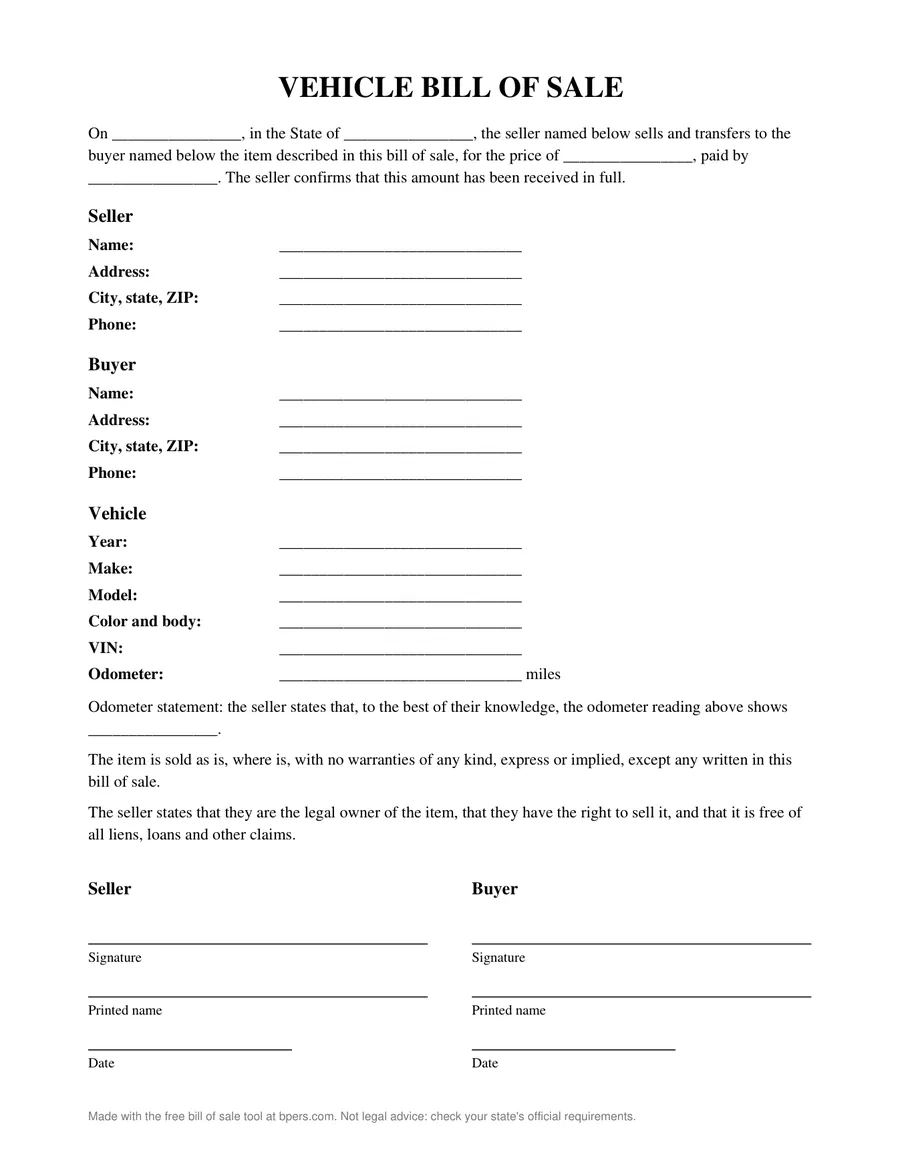
- The full names and addresses of the seller and the buyer.
- The date of the sale and the price paid.
- A clear description of the item. For vehicles: year, make, model and VIN. For boats: the 12-character hull identification number (HIN).
- For most vehicles, the odometer reading (see the next section).
- Whether the item is sold "as is" or with a warranty.
- Signatures of both people, and a notary's seal if your state asks for one.
The odometer statement
Federal law requires the seller to state the mileage when ownership of a vehicle changes hands. Vehicles from the 2011 model year onward need this disclosure until they are 20 years old; vehicles from the 2010 model year and older are exempt, as are vehicles over 16,000 lb and trailers (49 CFR 580.17).
On a titled vehicle the official disclosure is usually written on the title itself. The odometer line in this bill of sale is an extra record for both of you.
After the sale
- Seller: sign the title over to the buyer, keep your copy of the bill of sale, and tell your state's DMV that you sold the vehicle if your state has a notice-of-sale or release-of-liability form. Cancel your insurance only after that.
- Buyer: take the signed title and bill of sale to your DMV to register the vehicle in your name. States set their own deadline for this, often a few weeks.
- License plates: in many states the plates stay with the seller. Check your state's rule before you hand over the keys.
Common questions
Does a bill of sale need to be notarized?
Usually not, but some states do require it, and some require it only for certain sales (for example, when there is no title). Check your state's DMV page before you meet the buyer. If you need one, tick "Add a notary section" and sign in front of the notary, not before.
Is a handwritten bill of sale legal?
Yes. A bill of sale does not have to be typed. What matters is that it contains the details of the sale and both signatures. A typed one is simply easier for the DMV to read.
Does a bill of sale prove ownership?
It proves that a sale happened. For vehicles and boats that have a title, the title is the main proof of ownership, and the bill of sale supports it.
What does "sold as is" mean?
It means the buyer accepts the item in its current condition, with no promise from the seller that it will keep working. Leave the box unticked and describe the warranty under "Other terms" if you are giving one.
Is my information stored?
No. Everything you type stays in your own browser, and the PDF is made on your device. We never receive the names, addresses or numbers you enter.
Sources
- 49 CFR 580.17: odometer disclosure exemptions (eCFR)
- 33 CFR 181.25 and 181.29: boat hull identification number format and location (eCFR)
- 49 CFR Part 565: vehicle identification number requirements (eCFR)
Last checked November 26, 2026.