What a car bill of sale covers
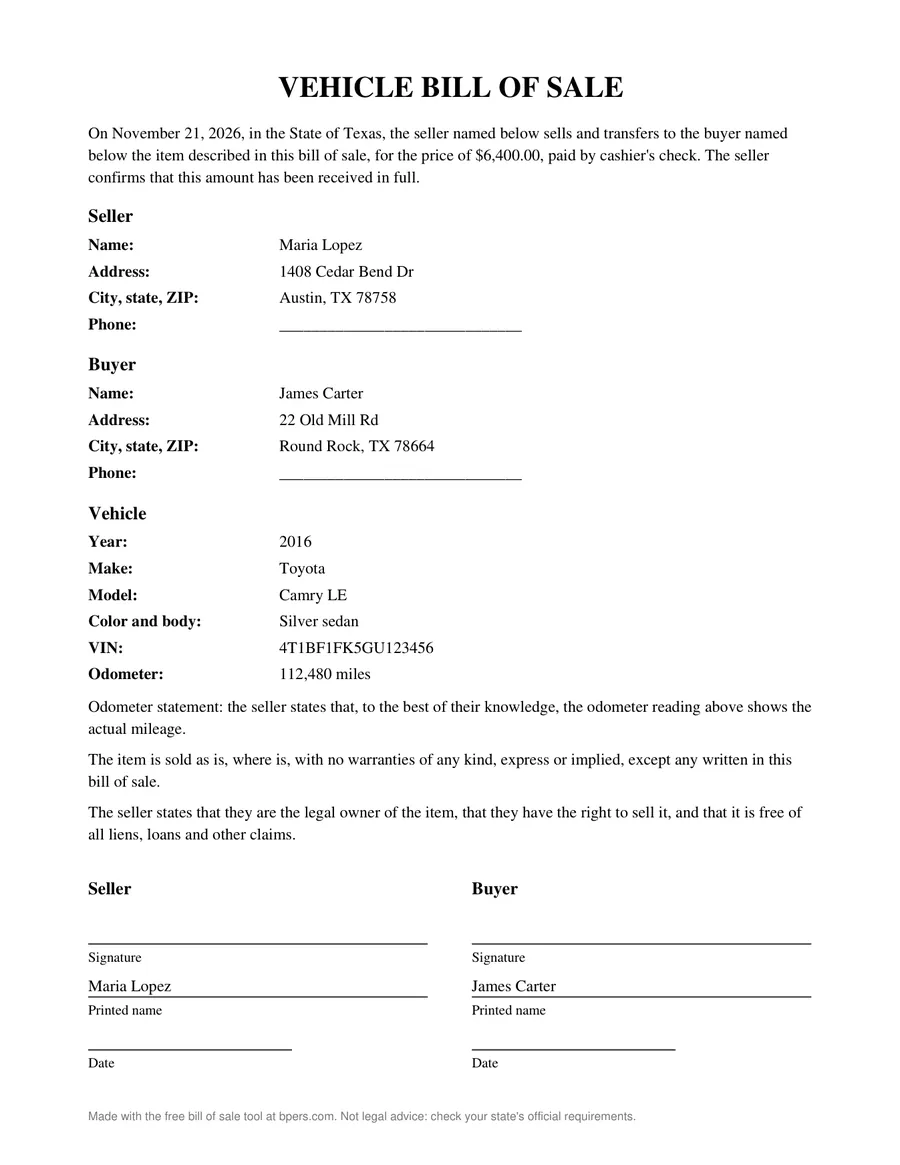
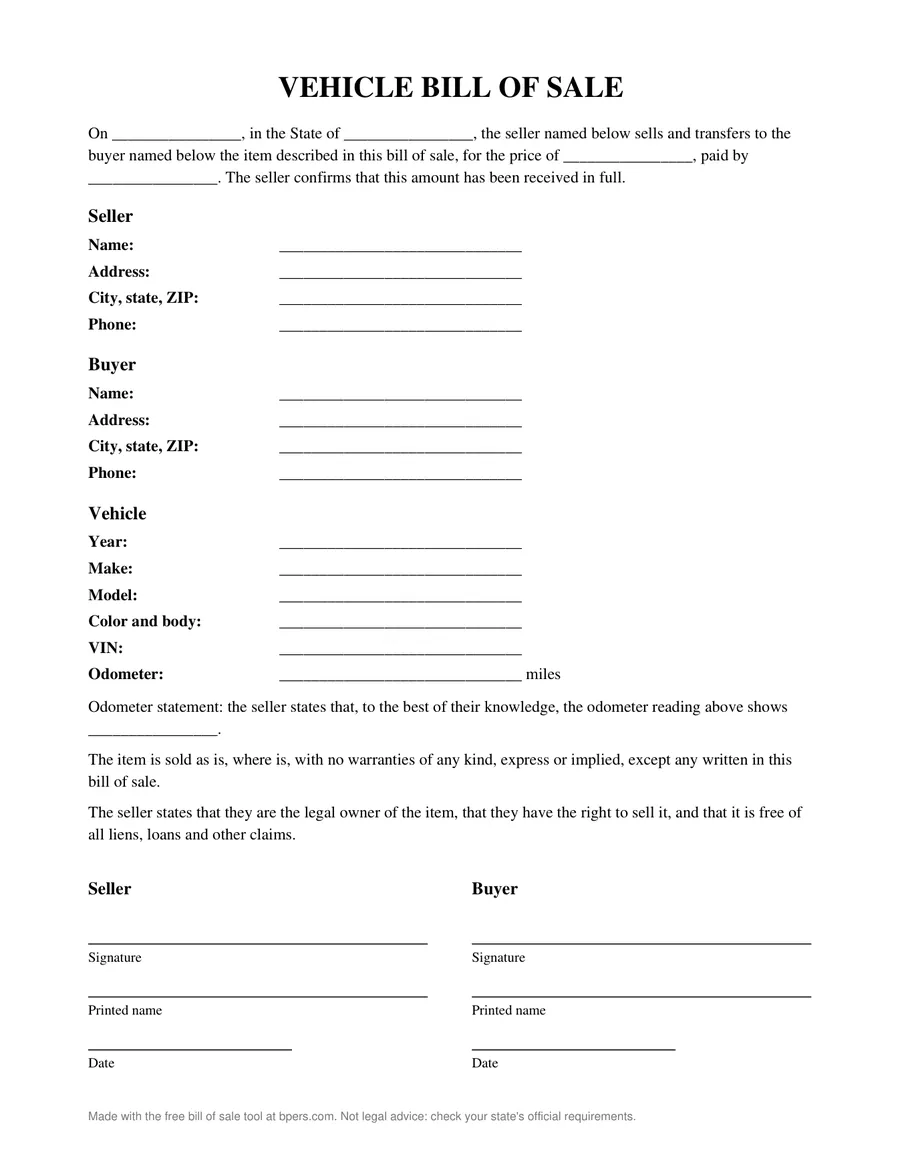
This form works for any passenger vehicle: cars, pickups, SUVs and vans. It records who sold the vehicle, who bought it, exactly which vehicle it was (year, make, model and VIN), the price, the date and the mileage.
It does not replace the title. In most states the signed title is what transfers ownership, and the bill of sale is the proof of the deal that goes with it. Some DMVs ask for one when you register; even where it is optional, both of you should keep a copy.
Check the VIN before anyone signs
The VIN is the vehicle's 17-character ID on cars made since 1981. Look in three places and make sure they all match the title, character for character:
- the title or registration card,
- the dashboard at the bottom of the windshield on the driver's side,
- the sticker on the driver's door frame.
If the numbers don't match, stop the sale until you know why.
The odometer statement
Federal law requires an odometer disclosure when most vehicles change hands: vehicles from the 2011 model year onward need one until they are 20 years old, while 2010 and older models, and vehicles over 16,000 lb gross weight rating, are exempt (49 CFR 580.17). On a titled vehicle the official disclosure normally goes on the title; the line on this bill of sale is an extra record for both of you.
Choose "the actual mileage" in almost every case. Choose "mileage beyond its mechanical limits" only if an old five-digit odometer has rolled past 99,999, and "not the actual mileage" if you know the reading is wrong, for example after an odometer replacement.
After the sale
- Seller: sign the title over, keep your copy of this bill of sale, and file your state's notice of sale or release of liability if it has one, so later tickets or tolls are not sent to you. Check whether the plates stay with you or go with the vehicle in your state.
- Buyer: arrange insurance before you drive away, then take the title and this bill of sale to your DMV to title and register it in your name. States set their own deadline, and many collect sales or use tax on the price.
Common questions
Can I sell a car without the title?
In most states you can't properly transfer a titled car without it. If the title is lost, apply to your DMV for a duplicate before the sale.
Should I write the real price?
Yes. The price on a signed bill of sale is often what tax is based on, and writing a lower figure to save tax can count as fraud.
Does a car bill of sale need to be notarized?
Only in some states. Tick "Add a notary section" if yours asks for it, and sign in front of the notary.
Sources
- 49 CFR 580.17: odometer disclosure exemptions (eCFR)
- 49 CFR Part 565: vehicle identification number requirements (eCFR)
Last checked November 26, 2026.